
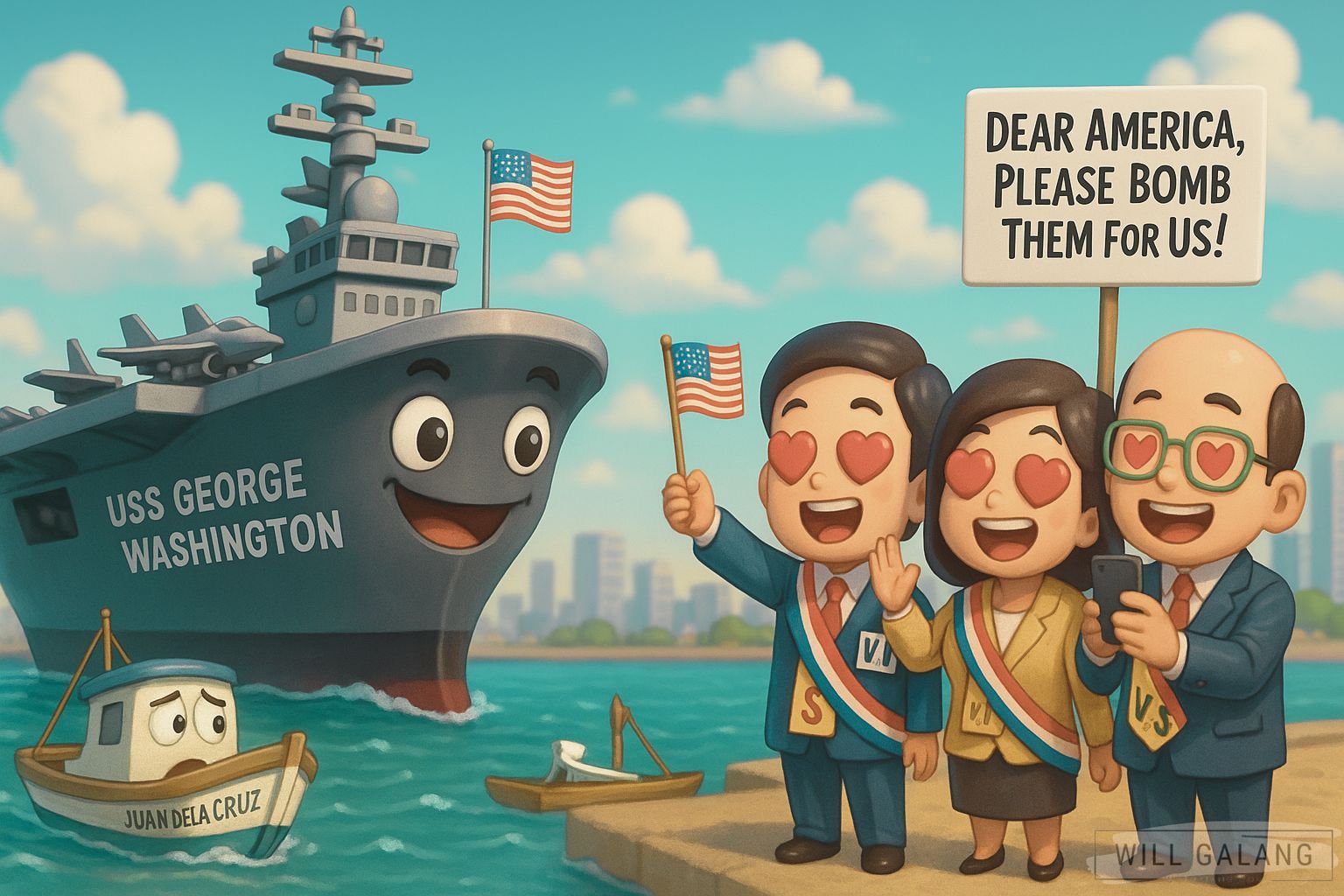
You can always tell who really runs the show in this country by seeing who gets the red-carpet treatment. This week, that honor went to the USS George Washington—a massive, nuclear-powered American aircraft carrier that sailed into Manila Bay like it owned the place. And judging by the way our politicians, military brass, and the elites fawned over it, they probably wish it did.
Like moths to a flame, the pro-U.S. elite couldn’t contain their excitement. Statements were drafted, hashtags trended, and photo ops were staged. To them, this wasn’t just a routine port visit—it was proof that Uncle Sam still has their back, preferably with a missile launcher pointed at Beijing.
Because what’s more thrilling than a floating symbol of American military might parked on our shores, especially as tensions rise in the so-called “West Philippine Sea”? (A term that sometimes feels more like a PR talking point than an actual defended territory.) For the Filipino ruling class, this is the dream scenario. Maybe—just maybe—this warship will do what our own navy hasn’t: finally send those Chinese coast guard ships packing.
Of course, nobody says that outright. The official statements are polished: “Reaffirming our alliance,” “commitment to stability,” “freedom of navigation.” But read between the lines, and the message is clear: This isn’t just a friendly visit—it’s a plea for backup.
A Longing for Colonial Comfort
This isn’t new. The Philippines has always had a complicated relationship with the U.S.—part dependence, part admiration, part self-denial. The elite, especially, have clung to this security blanket for generations. They don’t trust our own institutions—much less our own military—to stand up to China. So they outsource their patriotism to a foreign power.
It’s a strange kind of nationalism—one that waves the Philippine flag while secretly hoping America will fight its battles. Sovereignty, it seems, is selective. It matters when we’re defying Beijing, but not when we’re hosting U.S. troops, bases, or warships capable of carrying nuclear weapons.
Meanwhile, Everyone Else is Left Wondering…
While officials gush over fighter jets and carrier decks, the rest of the country has questions:
- What’s really being negotiated behind closed doors?
- Will this mean more joint patrols? More U.S. bases under EDCA?
- Are we turning into a staging ground for a conflict we can’t control?
And here’s the real kicker: If the U.S. and China ever go to war, the Philippines—cheering from the sidelines—will be among the first to suffer. Not the generals, not the politicians, not the social media influencers swooning over American sailors. But the ordinary Filipinos living near potential targets.
So yes, the USS George Washington is here. And yes, our leaders are beyond thrilled!
But before we roll out the welcome mat, maybe we should ask: Are we celebrating protection… or courting danger? Because there’s a fine line between an alliance and dependence—and right now, it looks a lot like the wake of an American warship cutting through our waters.